 Date: 20.10.2026 - 18:38
 Date: 20.10.2026 - 21:08

Sri Lanka-Turkey Trade Relations
Sri Lanka-Turkey Trade Relations
Sri Lanka- Türkiye bilateral economic relations
The economic relations between Sri Lanka and Türkiye have shown a steady and encouraging growth over the past three decades, strengthened by the expanding trade, institutional cooperation, and emerging investment and tourism opportunities.
Bilateral trade has increased significantly from a modest USD 17 million in 1990 to over USD 250 million in 2025, reflecting a positive trajectory despite still being below its full potential. Türkiye has steadily risen as an export destination for Sri Lanka, ranking as its 20th largest export market in 2024, compared to 81st position in 1977. Sri Lanka’s exports to Türkiye are heavily dominated by tea, which accounts for nearly 70% of total exports, followed by apparel, activated carbon, coconut-based products, rubber goods, and spices. On the import side, Türkiye ranks as Sri Lanka’s 24th largest supplier, with key imports including wheat flour, man-made filaments, machinery parts, plastics, and chemical products.
Ongoing institutional mechanisms, such as the Sri Lanka–Türkiye Joint Commission for Economic and Technical Cooperation (JCETC) have emphasized the importance of strengthening bilateral ties, specially achieving the agreed bilateral trade volume of USD 500 million. Since its inception in 2016, the JCETC has convened three sessions, most recently in Colombo in July 2025, focusing on a wide range of sectors including trade promotion, investment, engineering services, education, technology, agriculture, energy, and tourism. These engagements reflect a shared commitment to deepening cooperation in a sustainable and mutually beneficial manner.
Investment relations between the two countries remain relatively modest, even though the two sides are actively exploring opportunities in sectors such as manufacturing, agriculture, tourism infrastructure, logistics, renewable energy, pharmaceuticals, shipbuilding, and IT/BPO services. Business-to-business engagement has been facilitated by organizations such as the DEİK/Türkiye-Sri Lanka Business Council, which works closely with the Ceylon Chamber of Commerce to promote partnerships and investment flows.
Tourism has also emerged as a promising area of collaboration. Although Türkiye accounted for a relatively small share of tourist arrivals to Sri Lanka in 2024, post-pandemic recovery has been strong, with significant year-on-year growth. Enhanced air connectivity, particularly through Turkish Airlines with its daily flights to Colombo from Istanbul, has further supported this upward trend
List of Agreements MoUs between Sri Lanka and Türkiye
1. Agreement on Economic and Technical Cooperation between the Government of the Democratic Socialist Republic of Sri Lanka and the Government of the Republic of Turkey.
2. Trade Agreement between the Government of the Democratic Socialist Republic of Sri Lanka and the Government of the Republic of Turkey.
3. Agreement between the Government of Sri Lanka and the Government of Turkey on Co-operation and Mutual Administrative Assistance in Customs Matters
4. Agreement between the Government of the Democratic Socialist Republic of Sri Lanka and the Government of the Republic of Turkey for the Avoidance of Double Taxation the Prevention of Fiscal Evasion with Respect to Taxes on Income
5. MoU between the Ankara Chamber of Commerce and the Ceylon Chamber of Commerce of Sri Lanka
6. MoU between the Konya Chamber of Commerce and the Ceylon Chamber of Commerce of Sri Lanka
7. MoU between the Eskişehir Chamber of Commerce and the Ceylon Chamber of Commerce of Sri Lanka
8. MoU between the Manisa Chamber of Commerce & Industry and the Ceylon Chamber of Commerce of Sri Lanka
9. MoU between the Erzurum Chamber of Commerce and the National Chamber of Commerce of Sri Lanka
10. MoU between the Sinop Chamber of Commerce & Industry and the National Chamber of Commerce of Sri Lanka
11. MoU between the Adana Chamber of Commerce and the National Chamber of Commerce of Sri Lanka
12. MoU between the Adana Chamber of Industry and the National Chamber of Commerce of Sri Lanka
13. MoU between the Union of Chambers and Commodity Exchanges (TOBB) of Türkiye and the Federation of Chambers of Commerce & Industry of Sri Lanka
Sri Lankan Products
|
Ceylon Tea
|
|
Rubber based products
|
|
Ceylon Spices
|
|
Ceylon Cinnamon
The first Geographical Indication (GI) from Sri Lanka is registered in the EU. #CeylonCinnamon, a cultural and culinary heritage of Sri Lanka, is a unique variety of Cinnamon, with distinctive qualities enjoying a global reputation.
|
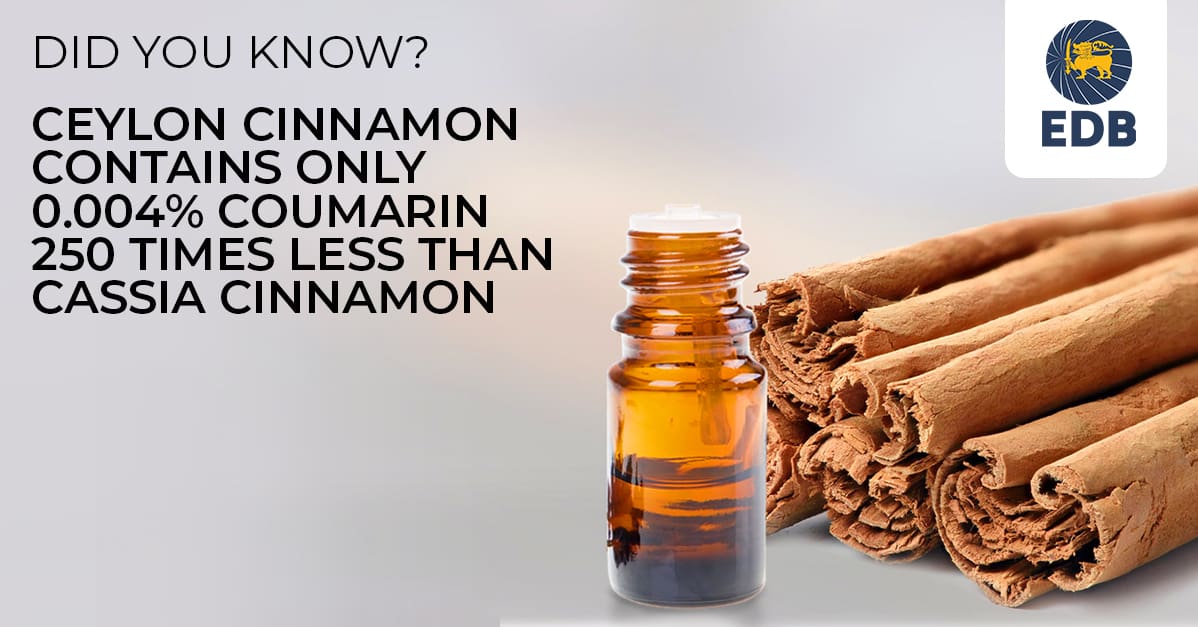
The Differences Between Ceylon Cinnamon and Cassia
| Ceylon Cinnamon | Cassia | |
| Stick | Quill is contained with number of folders or layer and dense centers | Quill is contained only one inward folded and hollow centers |
| Texture | Less firm, thin and papery | More firm, rougher thick bark |
| Colour | Tan brown, light color | Reddish dark borwn |
| Aroma | Potent fragrance | No fragrant |
| Taste | Lighter, delicate and sweet taste | Stronger and hotter taste |
|
Coconut and Coconut Based Products Sri Lanka supplies varieties top quality coconut based products
|
